
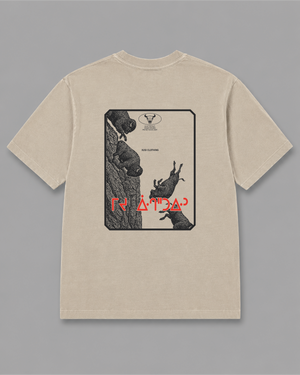
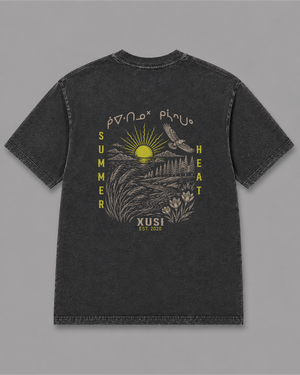
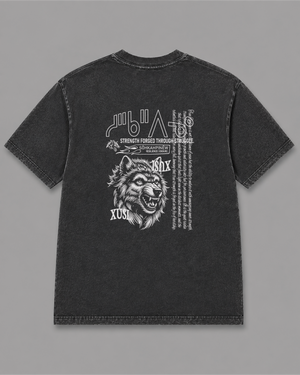
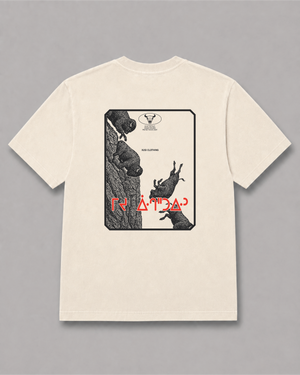

Every design we make carries a Cree word. People often ask us how to say it, what it means, and where the language comes from. So we wrote this: a short, plain guide to nêhiyawêwin for people who are just starting out.
We are not a language school, and we are not linguists. We are two brothers from a small reserve community in northern Saskatchewan who put Cree words on clothing because the language matters to us. For the real learning, we point you to the teachers, dictionaries and courses below.
What is nêhiyawêwin?
nêhiyawêwin is how Plains Cree speakers name their own language. The Canadian Encyclopedia explains that Plains Cree speakers call it nehiyawewin, "using the letter y," while Swampy Cree speakers say nehinawewin, "using the letter n instead of y."
That small difference tells you something important right away. Cree is not one single, uniform language. It is a group of closely related ways of speaking, spread across a very large part of the country.
Cree belongs to the Algonquian language family. According to the Canadian Encyclopedia, it "is spoken across Canada, from the Rocky Mountains to Labrador," and also in northern Montana.
Cree dialects: the y, th, n, l and r
One common way to tell Cree dialects apart is by a single sound. The same word shifts depending on where you are. The Canadian Encyclopedia lists these main dialects, among others:
- Plains Cree, the y-dialect
- Woods Cree, the th-dialect
- Swampy Cree, the n-dialect
- Moose Cree, the l-dialect
- Attikamek (Atikamekw), the r-dialect
It also lists James Bay/Eastern Cree, Montagnais and Naskapi as part of the wider Cree language picture.
The University of Saskatchewan Library's Cree guide names three dialects spoken in Saskatchewan: nêhiyawêwin (Plains Cree), nîhithawîwin and nêhinawêwin. Notice the y, th and n in each name. If you are learning in Saskatchewan, you will most likely meet one of these three.
If you are learning, ask your teacher which dialect they speak, and stick with it at first. Mixing dialects early on can be confusing.
Two ways to write Cree: SRO and syllabics
Cree is written in two main ways.
Syllabics
Syllabics are symbols that, in the Canadian Encyclopedia's words, "represent a combination of consonant and vowel, or only a consonant or vowel."
The creation of Cree syllabics is traditionally credited to "Reverend James Evans, a Christian missionary at Norway House in present-day Manitoba." The Canadian Encyclopedia also notes that "many Cree peoples have contested this story." We think it is worth knowing both.
Standard Roman Orthography (SRO)
Standard Roman Orthography, usually shortened to SRO, writes Cree with the Roman alphabet, the same letters used for English.
SRO is widely used in teaching. For example, the University of Saskatchewan's Advanced Oral and Written Cree course (EIND 220) states that "Standard Roman Orthography will be used to compose original writings such as poetry, verse, changes, legends and stories."
You do not have to choose one forever. The University of Saskatchewan Library's Cree guide even points to a converter that moves text between SRO and syllabics for Western Cree varieties.
You can see the Cree words we use, and the meanings we wrote for them, on our meanings page.
How many people speak Cree?
Statistics Canada's figures come from the census. In its report on Algonquian languages, based on the 2021 Census and released in 2025, Statistics Canada counts 87,875 people who could speak Cree languages, and 66,205 people with a Cree mother tongue. Cree languages were the largest group within the Algonquian language family.
Speakers are spread across several provinces. Statistics Canada reports that Cree languages were most commonly spoken in Saskatchewan (28.3% of speakers), Alberta (25.0%), Quebec (20.4%), Manitoba (18.3%) and Ontario (5.9%).
For wider context, Statistics Canada reports that about 237,420 Indigenous people in Canada could speak an Indigenous language well enough to conduct a conversation in 2021. In the Prairie provinces, "over three in five First Nations people who could speak an Indigenous language" spoke a Cree language.
The numbers also show the work ahead. Statistics Canada reports that in the Prairie provinces, Cree languages saw the largest numerical decline in speakers since 2016, a drop of 4,890 people, or 7.9%.
That is why learning matters. Every new speaker counts.
Where to start learning
Here are places to start. All of them are listed in the University of Saskatchewan Library's Cree language guide, or on university pages we checked.
Dictionaries
- itwêwina Plains Cree Dictionary, an online dictionary for Plains Cree
- Online Cree Dictionary
- Alberta Elders' Cree Dictionary
Books
- mâci-nêhiyawêwin / Beginning Cree, from the University of Regina Press. The publisher describes it as "a self-study aid" with "basic grammar units and everyday vocabulary items."
- Cree Language Structures: a Cree Approach
- nēhiyawētān kīkināhk = Speaking Cree in the home
Websites and apps
- Cree Literacy Network
- Kawacatoose Cree Language App, on iOS and Android
Courses
The University of Saskatchewan offers Cree courses, including CREE 101 and CREE 120. Its course catalogue notes that non-Cree speakers who complete both "will have acquired the appropriate oral and written proficiency" to move into the advanced course.
People
The best teachers are still people. Elders, fluent speakers in your family, language nights at a friendship centre or band office. Books and apps help. Speaking with someone helps more.
Tips for new learners
- Learn a few words you will actually use. Greetings, family words, words for the land around you.
- Say them out loud. Cree is a spoken language first.
- Ask before you use a word publicly. Especially on a sign, a logo or a shirt. Meanings can be layered, and spelling can differ between communities.
- Be patient with yourself. Many Indigenous people are learning their own language as adults, because of what residential schools took from their families. There is no shame in starting now.
Why we put Cree on our clothing
For us, a Cree word on a hoodie or an A-frame hat is a small way to keep the language in view. Someone reads it. Someone asks what it means. Someone tries to say it. That is a start.
You can browse our tees or everything we make, and read the meanings behind each word on our meanings page. And if you work with Indigenous youth ages 10 and up, our Strong Roots Strong Future workshop is another way we try to pass things on. See our youth workshops page.
Sources
- The Canadian Encyclopedia: Cree Language
- University of Saskatchewan Library: Cree language revitalization guide
- Statistics Canada: Indigenous Language Families: Algonquian languages
- Statistics Canada: Indigenous languages across Canada (Census in Brief, 2021 Census)
- University of Saskatchewan: Course Catalogue (EIND)
- University of Regina Press: mâci-nêhiyawêwin / Beginning Cree

Written by XUSI, an Indigenous-owned clothing and screen printing brand from Saskatoon on Treaty 6 territory. Our story · What the words mean