
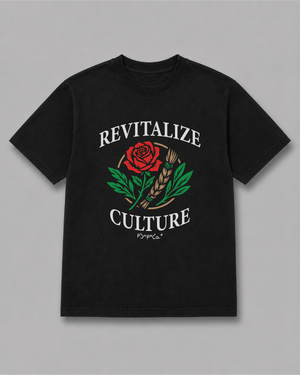
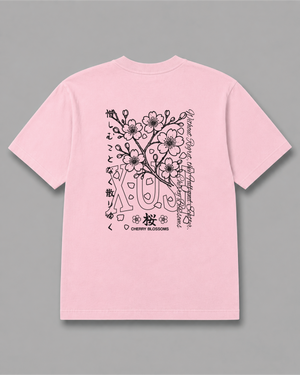
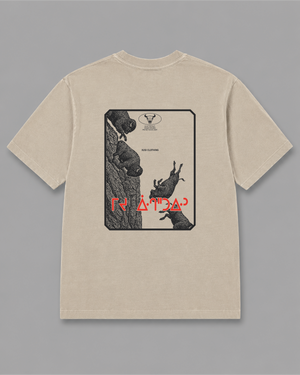
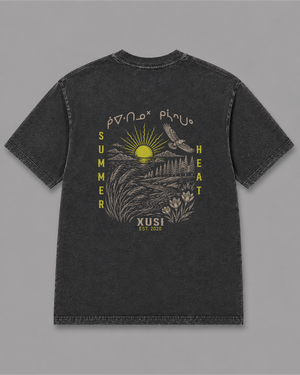
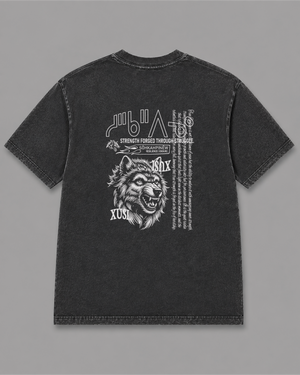
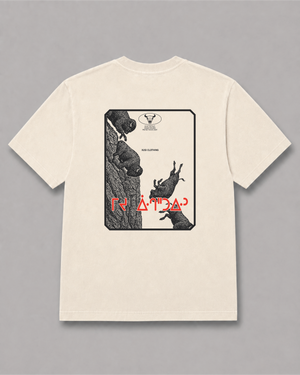

A good event shirt does a few jobs at once. It helps people find each other in a crowd. It makes volunteers easy to spot when someone needs help. And for a lot of people, it's the thing they keep long after the day is over.
We're XUSI, an Indigenous-owned clothing and screen printing shop in Saskatoon, on Treaty 6 territory. We print custom event shirts for community walks, tournaments, school events and volunteer crews at gatherings. This post is the planning side: when to start, what colours hold up, how to size a mixed group, how to handle language on a shirt respectfully, and how to build a budget.
Start with what the shirt needs to do
Before colours or sizes, answer one question: who's wearing it, and why?
- Participants at a walk or run want something comfortable they'll wear again.
- Volunteers and crew need to be seen. Readability from across a field or a gym matters more than fine detail.
- Teams at a tournament might need different colours per team with the same event design.
- School events usually mean a wide range of sizes, including youth.
Plenty of events need two versions. One design for everyone, and a second colour or a "Volunteer" or "Crew" print on the back for the people running things. That's one of the simplest ways to make a busy day run smoother.
Timelines for custom event shirts
Work backwards from the event date. You need time to lock the design, collect sizes, get a quote, approve a proof, print, and then actually hand shirts out. That last step gets forgotten a lot.
Our timing depends on the size of the order and the time of year, and we confirm it in your quote. We don't promise a set turnaround, because a 15-shirt order in a quiet week and a 300-shirt order in a busy season are two different things.
A practical order of operations:
- Pick your coordinator, the one person who approves things.
- Settle the design and the wording, including any language review (more on that below).
- Collect sizes with a hard cutoff.
- Send us everything for a quote.
- Approve the proof quickly.
- Plan pickup or shipping, and plan how shirts get to people before the event starts.
The earlier you reach out, the more options you'll have on garments and colours.
Colours that stay readable
An event shirt gets read from a distance, in sunlight, in a dim hall, sometimes on a moving person. Contrast matters a lot more than it does on a screen.
The web accessibility guidelines from the W3C are written for screens, but the idea carries over. They explain that people with low vision often have trouble reading text that doesn't contrast with its background, and that larger text with thicker strokes is easier to read at lower contrast (see Sources). On a shirt, that means:
- Light ink on dark shirts, or dark ink on light shirts. Avoid mid-tone on mid-tone.
- Keep key words big and bold, especially for volunteer shirts.
- Thin script fonts look lovely up close and get lost from across a room.
- Be careful with red on green or similar pairs, which can be hard for some people to tell apart.
We print up to 4 colours per design. For an event shirt, fewer colours with strong contrast usually reads better than more colours fighting each other. Design help is included, so we can help you adjust a design before it prints.
Sizing a mixed group
Community events bring together everyone: kids, Elders, teens, volunteers of every build. That makes sizing the trickiest part of the whole order.
A few things that help:
- Ask people directly with a simple form, and include a link to our size guide so they can check measurements.
- Ask us about youth sizes early. Some garment brands carry youth sizes (Bella+Canvas, for example, lists youth, toddler and infant sizes), but not every style comes in them, so it can affect which shirt we recommend.
- Keep a small buffer of common adult sizes for walk-up participants and last-minute volunteers.
- Think about fit. Some styles run slimmer. For a big mixed group, a relaxed, forgiving fit usually keeps more people happy.
If you truly can't collect sizes, tell us your headcount and who's coming, and we'll talk through a sensible spread. It won't be perfect, but it'll be closer than guessing alone.
Putting a Nation's or organization's language on a shirt
A lot of the event shirts we print carry words in an Indigenous language: an event name, a greeting, a theme. It can mean a lot to the people wearing it. It also needs care.
Canadian Heritage notes that three quarters of the 90 living Indigenous languages in Canada are identified by UNESCO as endangered, and that these languages are an integral part of Indigenous Peoples' cultures and identities. The United Nations has proclaimed 2022 to 2032 the International Decade of Indigenous Languages, with UNESCO describing Indigenous Peoples as key stakeholders in that work (see Sources).
For a shirt, our advice is simple:
- Have fluent speakers approve the wording. Ideally from the Nation or community whose language it is. Online translators and word lists aren't enough.
- Check the spelling system. Some languages are written in more than one way, and communities may prefer a specific one. Ask which to use.
- Confirm the meaning in context. A word that's correct on its own may not fit the way it's being used.
- Get sign-off in writing, even a short email, so the final text is clear to everyone.
- Send us the approved text exactly as it should appear, including any special characters or syllabics.
We won't translate or suggest wording in a language for you. That belongs with the speakers and the community. What we'll do is print it carefully and send a proof so the approved speaker can check it before anything goes to press.
The same goes for logos, symbols or designs tied to a Nation or organization. Get permission from whoever holds them first.
Budgeting with our prices
Here's how our screen printing pricing breaks down:
- Print cost depends on quantity and colours.
- Garments are priced on top of the print cost.
- 10 garment minimum.
- Full quote before anything is printed.
Each print location counts as a print. A shirt with a front design and a "Volunteer" back print is two prints plus the garment. Two ways to stretch a budget:
- Keep one shared design across the whole order and change the shirt colour for volunteers instead of adding another print. Ask us how that affects your quote.
- Put your money in the garment if people will wear it for years, or in extra quantity if the goal is simply to cover everyone on the day.
If you've got a grant or a fixed budget, tell us the number. We'd rather build a quote that fits than send one you have to cut down. For more on what moves the price, see our post on screen printing cost per shirt.
A note on Orange Shirt Day
We get a lot of questions about shirts for September 30. That's its own topic, with its own considerations, so we wrote a separate guide: Orange Shirt Day shirts for schools and organizations.
Getting started
Send us your headcount, the event date, your design or idea, any approved language text, and if you'll pick up in Saskatoon or need shipping in Canada. You can reach us through our screen printing page, and if your group supports youth programming, have a look at our community support page too.
Questions people ask
Can we get youth and adult sizes in one order?
Often, yes. It depends on the garment, so ask us early and we'll suggest styles that come in the range you need.
Can volunteers have a different shirt colour?
Yes. Tell us how many of each colour, and we'll include it in your quote.
Will you translate our event name?
No. Please have fluent speakers from the community approve the wording, then send us the final text and we'll send a proof.
How far ahead should we order?
As early as you can. Timing depends on order size and time of year, and we confirm it in the quote.
Sources
- W3C, Understanding Success Criterion 1.4.3: Contrast (Minimum)
- Government of Canada, Celebrate Indigenous languages
- UNESCO, International Decade of Indigenous Languages 2022–2032
- Bella+Canvas, wholesale blank apparel and kids sizing

Written by XUSI, an Indigenous-owned clothing and screen printing brand from Saskatoon on Treaty 6 territory. Our story · What the words mean