
Indigenous Dawson City: Tr’ondëk Hwëch’in Territory, Nations and Community
An introduction to Dawson City: its history, the Nations whose lands it sits on, and Indigenous community life today, with sources.
About Dawson City
Dawson City sits on the east bank of the Yukon River at the mouth of the Klondike River, about 530 km north of Whitehorse. The Klondike Gold Rush turned it into a boom town of roughly 16,000 people in the summer of 1898, and it served as Yukon’s capital until 1953. Since the last large gold dredge shut down in 1966, tourism has been the main industry, though placer mining continues. Parks Canada protects landmarks such as the Palace Grand Theatre and the sternwheeler SS Keno, and Discovery Day each August marks the 1896 gold find. This is the homeland of the Tr’ondëk Hwëch’in, whose Dänojà Zho Cultural Centre on the waterfront shares Hän heritage and contemporary life. In 2023 the Tr’ondëk-Klondike was inscribed as a UNESCO World Heritage Site, recognizing the First Nation’s experience of the gold rush era, including at Moosehide.
Dawson City history
Before the stampede, the Hän-speaking Tr'ondëk Hwëch'in used this valley for hunting and gathering. Tr'ochëk, a fishing camp where the Klondike meets the Yukon, was an important summer gathering place. It was also a base for moose hunting up the Klondike Valley. On August 16, 1896, George Carmack, Skookum Jim and Tagish Charley found gold in the Klondike. That same month, trader Joseph Ladue staked the flat as a townsite, expecting a rush. William Ogilvie surveyed it and named it for George M. Dawson, director of the Geological Survey of Canada. By the summer of 1898, about 30,000 people had crowded into the Klondike region. In spring 1897, Chief Isaac led the community a few kilometres downstream to Moosehide. The site offered fresh creek water, timber, trails to hunting grounds and good salmon fishing. UNESCO's Tr'ondëk-Klondike listing traces this colonial transformation from the Fort Reliance fur post in 1874 to the consolidation of colonial authority by 1908. Nearly a century later, the Tr'ondëk Hwëch'in Final Agreement was signed on July 16, 1998. It took effect that September, and the Nation adopted its own constitution the same year.
Treaty and territory
Dawson City is on the traditional territory of the Tr’ondëk Hwëch’in.
Nearby: Moosehide · Mayo · Pelly Crossing
Indigenous Dawson City today
The Tr'ondëk Hwëch'in Government runs its main office on Front Street in Dawson City, with a second office in Whitehorse. In 2019 the Nation counted 865 members, most of them living off reserve. Its departments cover education, justice, housing, natural resources, wellness and heritage. Language work sits at the centre of the heritage program. The Hän language is shared by the Tr'ondëk Hwëch'in and a small community in Eagle Village, Alaska. The Nation's own materials use Hän names throughout, and it presents language resources under the name Hän Hënjìk. The Nation also keeps a public calendar. It has hosted the Moosehide Gathering at the historic village downriver. It marks the National Day for Truth and Reconciliation on September 30 and holds a fall General Assembly. The UNESCO site includes eight parts, each with a story. Alongside Dawson City and Moosehide Village, they include Tr'ochëk, Forty Mile and its Dënezhu graveyard, and Fort Reliance. The list also covers Fort Cudahy and Fort Constantine, and Black City, or Tthe Zrąy Kek'it. Together they illustrate how the region was transformed from 1874 to 1908.
Life in Dawson City
Dawson City counted 1,577 residents in 2021, up from 1,375 in 2016. Gold mining still matters, but the Canadian Encyclopedia expects tourism to lead as placer deposits run down. Dawson keeps a busy arts calendar for a small northern town. The Klondike Institute of Art and Culture presents the Dawson City International Short Film Festival in April. It also runs the Yukon Riverside Arts Festival in June and a print and publishing festival in August. Since 2001, its artist residency has partnered with Parks Canada, and the ODD Gallery shows regional and international work. Literary history lives here too. Visitors can see Robert Service's log cabin and Berton House, Pierre Berton's childhood home, now a writers' retreat. In 1978, construction crews uncovered more than 500 early nitrate films buried in the town. The climate is extreme. Dawson has touched 35.0°C in summer and plunged to −58.3°C in February 1947. The Downtown Hotel's Sourtoe Cocktail, served with a real mummified toe, has drawn wide media attention.
Dawson City seasons and weather
Deep cold settles into the Klondike valley in winter, with very short days, while summer brings nearly round-the-clock light and warm afternoons. Heavy layers and a toque are essential from fall through spring.
More on the region: Indigenous Yukon · all of Canada.
Keep learning in the XUSI Journal
- First Nations, Métis and Inuit: What’s the Difference?
- How to Write a Land Acknowledgement That Means Something
- Orange Shirt Day & the National Day for Truth and Reconciliation
- National Indigenous Peoples Day and History Month: A Guide
- All Journal articles
Dawson City questions
Can I order XUSI gear to Dawson City?
Yes. We ship from Saskatoon, and orders usually leave within 1–3 business days. The shipping cost is calculated at checkout, and orders of $90 or more ship free within Canada.
If something ordered to Dawson does not work out, can I send it back?
Returns can be requested within 30 days.
Can a Dawson City arts group or festival order custom printed shirts?
Yes. Custom screen printing starts at 10 garments, with up to 4 colours per design, and every order is quoted before printing. Design help is included. We print in Saskatoon and ship to Dawson City, so order well ahead of a festival date to allow for northern delivery.
Does XUSI make designs in the Hän language?
No. Our designs carry Cree words, each with its story on our meanings page, because we are a Indigenous-owned company from Saskatoon. We do not speak for Hän culture. A Dawson City group that wants its own design can work with us through custom screen printing, which includes design help.
Last reviewed . Facts on this page come from the sources listed below.
Indigenous clothing from XUSI
In Klondike country, XUSI is just an order away. This Indigenous-owned brand from Saskatoon ships hoodies, tees and hats to Dawson City customers, from the historic boardwalks downtown to homes up the valley.
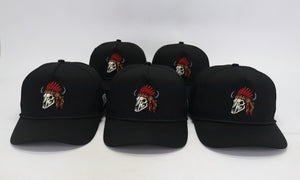
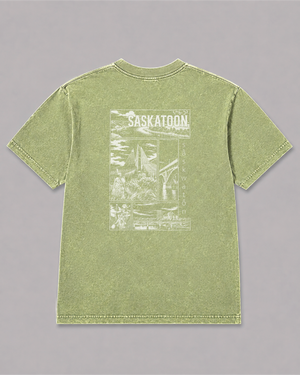
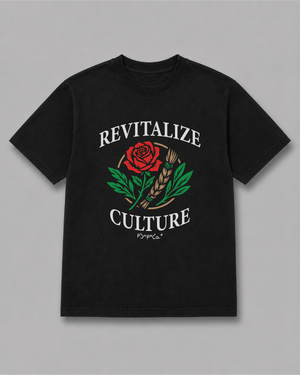
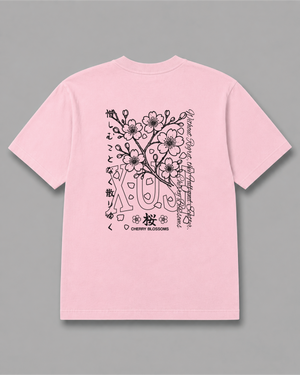
Dawson's year runs from midnight sun to deep cold, and we'd dress for both. Under the long summer light, a heavyweight cotton tee and an A-frame snapback suit a paddle on the Yukon River. They work just as well for a walk along Front Street past the old boardwalk buildings. For the short film festival in April, when spring is still cool, the Revitalize Culture crewneck is a good pick. The Black Oni long sleeve layers well for September evenings as the season turns. Once winter settles into the valley, a heavyweight hoodie belongs under every parka.