
Indigenous Fredericton: Wolastoqiyik Territory, Nations and Community
An introduction to Fredericton: its history, the Nations whose lands it sits on, and Indigenous community life today, with sources.
About Fredericton
Fredericton, the capital of New Brunswick, lies along the Saint John River roughly 135 km inland from the Bay of Fundy. Wolastoqiyik take their name from the river they call the Wolastoq, meaning beautiful and bountiful river, and Sitansisk (St. Mary’s First Nation) is located within the city. The Wolastoqey communities of Bilijk (Kingsclear) and Welamukotuk (Oromocto) are also in the capital region, and Sitansisk hosts an annual powwow. The University of New Brunswick, which traces its roots to King’s College, is described as Canada’s oldest English-speaking university, and St. Thomas University is also in the city. Government, the hospital, the university and nearby CFB Gagetown are major employers, and the city is growing a technology sector focused on areas such as cybersecurity. The Beaverbrook Art Gallery and the Harvest Jazz and Blues Festival each September draw visitors from across the Maritimes.
Fredericton history
For generations the Wolastoqiyik moved with the seasons, keeping villages along the river where they fished and hunted. One major village stood at Meductic, about 75 kilometres to the west. The Canadian Encyclopedia notes it was left in the early-to-mid 1700s in favour of Ekwpahak. French governor Joseph Robinau de Villebon built Fort Nashwaak at the mouth of the Nashwaak River in the early 1690s. Cut off from trade routes, it had failed by 1698. Acadians later settled St. Anne's Point, and British forces destroyed their communities in 1758. In 1725 the Wolastoqiyik, Passamaquoddy and Mi'kmaq signed the first Peace and Friendship Treaties with the British Crown. The City of Fredericton notes these treaties recognized Indigenous title rather than surrendering land. Loyalists arrived at St. Anne's Point in 1783. Two years later Governor Thomas Carleton made it New Brunswick's capital, naming it for Prince Frederick, Duke of York. Its planners reserved land for government, the military, a university and an Anglican church. Permanent Wolastoqey communities were set up at Bilijk in 1795, Sitansisk in 1867 and Welamukotuk in 1895. Fredericton was incorporated as a city on March 30, 1848. In 1883 the Infantry School Corps, later the Royal Canadian Regiment, was formed here.
Treaty and territory
Fredericton is on the unceded territory of the Wolastoqiyik, covered by the Peace and Friendship Treaties.
Nearby: Sitansisk (St. Mary’s First Nation) · Bilijk (Kingsclear First Nation) · Welamukotuk (Oromocto First Nation) · Oromocto · New Maryland
Indigenous Fredericton today
Sitansisk is one of six Wolastoqey communities along the river. The Wolastoqey Nation in New Brunswick, based on Dedham Street in Fredericton, is the technical advisory body for all six. It reviews projects and gives advice on land, fisheries, forestry and environmental assessments. Its logo, designed by Natalie Sappier, draws on elements important to Wolastoqey culture. The City of Fredericton has taken several steps toward reconciliation. The Wolastoqey flag now flies permanently at City Hall, and September 30 is a municipal holiday for the National Day for Truth and Reconciliation. The city has begun acting on 14 of the Truth and Reconciliation Commission's Calls to Action. Sitansisk presented its flag for display in council chambers, along with a Wampum Belt marking renewed relations between the two governments. The city also provides space for Kehkimin, a Wolastoqey language immersion school. The Wolastoqiyik belong to the Wabanaki Confederacy with the Mi'kmaq, Abenaki, Penobscot and Passamaquoddy. At the University of New Brunswick, the Mi'kmaq-Wolastoqey Centre teaches Wabanaki histories, cultures and treaty rights and supports Indigenous students.
Life in Fredericton
Fredericton had 58,220 residents in 2016, according to The Canadian Encyclopedia. It became a Cathedral City in 1845, which led to the building of Christ Church Cathedral. The University of New Brunswick received its royal charter as King's College in 1828. Military history is visible in the Garrison District, where heritage walking tours pass through Officers' Square. The river shapes daily life. The Bill Thorpe Walking Bridge is one of the city's best-known sights. Fredericton also maintains a network of Wolastoq trails and parks. Queen Street is the heart of the downtown, and the city promotes heritage walking tours of its older blocks. The city keeps growing outward. It absorbed Devon in 1945 and Nashwaaksis and Marysville in 1973, and expanded again in 2023 with Douglas and surrounding areas.
Fredericton seasons and weather
Being inland, Fredericton sees colder winters and warmer summers than the coast. Plan on insulated layers and a toque in January, and lighter tees for hot river-valley afternoons.
More on the region: Indigenous New Brunswick · all of Canada.
Keep learning in the XUSI Journal
- First Nations, Métis and Inuit: What’s the Difference?
- How to Write a Land Acknowledgement That Means Something
- Orange Shirt Day & the National Day for Truth and Reconciliation
- National Indigenous Peoples Day and History Month: A Guide
- All Journal articles
Fredericton questions
Can I pick up my order in Fredericton?
Pickup is available only in Saskatoon. We ship to Fredericton from Saskatoon, with the shipping cost shown at checkout and free shipping within Canada on orders of $90 or more.
Our Fredericton student group needs shirts. What is the minimum?
Custom screen printing needs at least 10 garments. Every order gets a full quote before anything is printed, and design help is included. We print in Saskatoon and ship the order to you.
Could a UNB Indigenous student group or a Fredericton language program order custom shirts?
Yes. Custom screen printing starts at 10 garments, with up to 4 colours per design, and every order is quoted before printing. Design help is included. We print in Saskatoon and ship the order to Fredericton, which suits a student group, a class or a volunteer team.
Do XUSI designs use Wolastoqey language or art?
XUSI is an Indigenous-owned brand from Saskatoon, and many of our designs carry a Cree word, with its story on our Meanings page. Fredericton sits on Wolastoqey homeland, and that language and art belong to the Wolastoqiyik. Many of our designs carry a Cree word, with its story on our Meanings page.
Last reviewed . Facts on this page come from the sources listed below.
Indigenous clothing from XUSI
XUSI brings Indigenous-made streetwear from Saskatoon to Fredericton, shipping its tees, hats and hoodies to the New Brunswick capital along the Wolastoq, whether you live downtown, on the north side or out in the surrounding region.
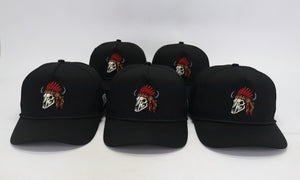
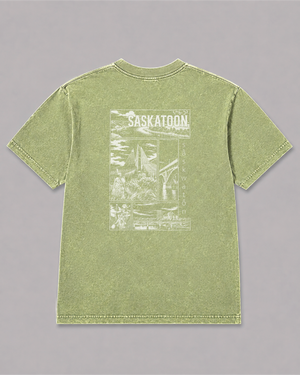
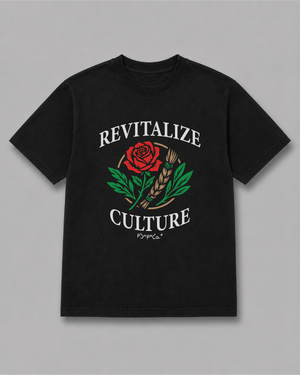
In Fredericton, much of the year is spent outside by the Wolastoq. Crossing the Bill Thorpe Walking Bridge on a July afternoon, a generous-fit heavyweight tee keeps things simple. A snapback shades your eyes from the water's glare. On a Garrison District heritage tour, the Golden Era ringer adds a bit of colour. As the leaves turn along the river trails, the Black Oni long sleeve suits an evening jog. Deep in a New Brunswick January, slip the Revitalize Culture crewneck under your coat for the walk to class. Our Saskatoon print shop also takes custom orders from Fredericton groups, from a UNB club to a language class.