

"Heavyweight" shows up on a lot of shirt tags and product pages. It sounds simple, but brands use the word loosely. This guide explains what the numbers on a spec sheet mean, so you can tell a heavyweight t-shirt from a regular one before you buy or print.
What GSM and oz/yd² actually measure
Fabric weight tells you how much a set area of fabric weighs. It does not measure the weight of the whole shirt.
- GSM means grams per square metre (g/m²). It is the common international unit.
- oz/yd² means ounces per square yard. North American brands often list this one.
To convert between them, use one number: 1 oz/yd² equals about 33.9 g/m². Fashion-Incubator shows the math: 28.35 grams per ounce, divided by 0.836 square metres per square yard, gives 33.906.
- oz/yd² x 33.9 = g/m²
- g/m² ÷ 33.9 = oz/yd²
So a 180 g/m² tee is about 5.3 oz/yd². A 203 g/m² tee is about 6.0 oz/yd².
Watch for linear yards
Some sheets list weight per linear yard instead of per square yard. A linear yard is a length of fabric at whatever width it was made. Fashion-Incubator notes that you need the fabric width to compare the two, which is why GSM is the cleaner standard. If a sheet just says "oz" with no unit, treat the number with care.
Where common tees sit on the scale
Here are three well-known tees, with weights taken from the manufacturers' own pages.
| Tee | Listed weight | Fabric |
|---|---|---|
| Bella+Canvas 3001 | 4.2 oz | 100% combed and ring-spun cotton, 32 singles |
| Gildan 5000 Heavy Cotton | 180 g/m² | 100% US cotton |
| American Apparel 1301 Heavyweight | 203 g/m² | 100% US cotton |
Notice the names. Gildan calls its 180 g/m² tee "Heavy Cotton." American Apparel calls its 203 g/m² tee "heavyweight." The label is marketing. The number is what you can compare.
How weight changes feel, drape and durability
Feel
Heavier fabric feels thicker in the hand and less see-through. Lighter fabric can feel softer, but weight is only part of the story. Bella+Canvas says lighter fabrics "tend to be made from combed and ring-spun cotton and are typically much softer than the heavy weight, open-end alternatives." Yarn matters as much as grams.
Drape
Drape is how fabric hangs on the body. Lighter jersey tends to fall close to the body and move more. Heavier jersey has more body of its own, so it keeps more of its shape and sits away from you a little.
Durability
More fabric per square metre generally means more material to wear through. Still, weight is not a guarantee. Seams, yarn and care all play a part. Look for construction details like taped neck and shoulders, which American Apparel lists on the 1301 "for comfort and durability." How you wash a shirt matters too; our guide on washing screen-printed t-shirts covers that.
Cotton, blends and ring-spun yarn
Weight tells you how much fabric there is. Fibre and yarn tell you what kind of fabric it is.
100% cotton
The University of Georgia Extension describes cotton as absorbent and durable, and notes that it wrinkles unless treated. Cotton Incorporated gives cotton a moisture regain of about 7% to 8.5% under standard conditions. That moisture handling is a big reason cotton tees feel comfortable in warm weather.
Cotton-poly blends
Polyester behaves differently. Cotton Incorporated lists its moisture regain at only 0.4%. The UGA Extension describes polyester as strong and wrinkle-resistant, but says it "may pill and attract lint" and absorbs body oils. Blending the two fibres mixes these traits, so a blend lands somewhere between them. Always check the exact percentages.
Ring-spun and combed cotton
Ring-spun is about the yarn, not the fibre. Bella+Canvas explains that ring-spun yarn is "smoother and longer" than open-end yarn, which is "bulky, fuzzy and creates an uneven knit." Combing removes impurities. You will also see "singles," a yarn measure: the higher the singles number, the finer the yarn. Bella+Canvas says most budget shirts use 18 to 20 singles, while its own tees use 30 or more.
How weight and fibre affect printing
For screen printing, the surface matters most. A smooth, tight knit gives ink a clean base. Bella+Canvas describes its ring-spun 3001 as having "a smooth surface perfect for printing of any kind."
Blends bring one more thing to watch. ScreenPrinting.com explains that dye migration happens in polyester and poly-cotton blends when curing heat makes the garment's dye sublimate into the ink. It recommends low-bleed inks and a "low and slow" cure. White polyester is not affected, since it has no dye to move.
We work through these details for every order on our screen printing side. Before anything is printed, you get a full quote.
How to read a t-shirt spec sheet
- Find the weight and its unit. Check whether it says g/m², oz/yd² or just oz. Convert so every shirt uses the same unit.
- Read the fibre content by colour. Heathers often use a different blend. The Bella+Canvas 3001 is 100% cotton in solids, but its Ash colour is 99% cotton and 1% polyester.
- Check the yarn. Look for "ring-spun," "combed" and a singles number. Higher singles mean finer yarn.
- Check construction. Side-seamed or tubular body, taped shoulders and collar type all change how the shirt wears.
- Read the fit words. "Classic," "tailored," "relaxed" and "generous" each mean something different. Then check the size chart.
Our tees: heavy feel, generous fit
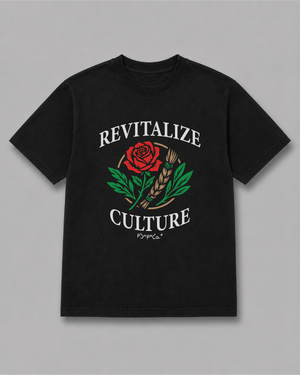
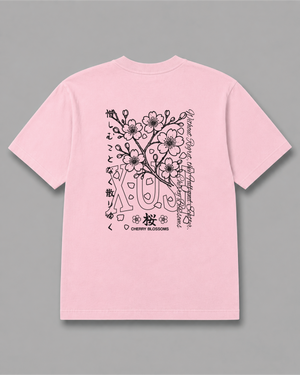
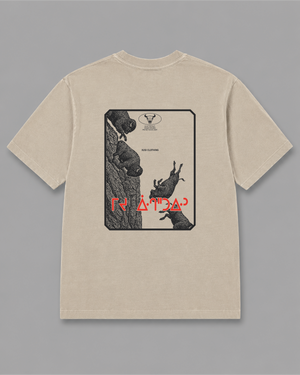
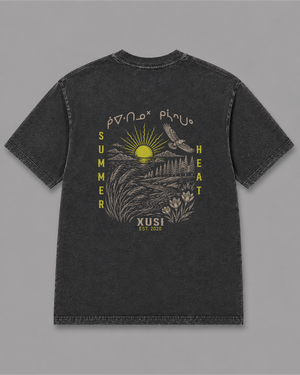
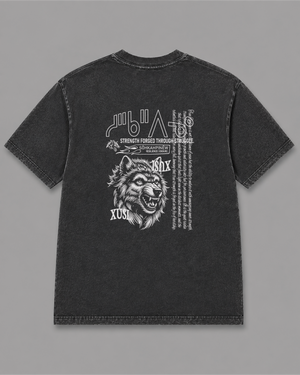
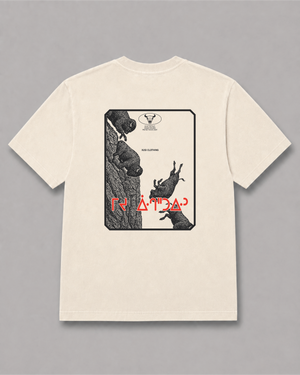
Our own tees are 100% cotton and shrink free. They have a heavy and sturdy feel and a generous fit, with printed logos. Most are $49.95. We do not publish a GSM for them, so we will not guess one here.
Our Golden Era ringer tees are different on purpose. They are a 50/50 cotton-poly blend with a classic fit, at $39.95. If you want a lighter, blended feel, the ringer is the one to try.
Browse both in our tee collection, and check the size guide before you order. We offer free shipping across Canada on orders of $90 or more, and local pickup in Saskatoon.
Related reading: Best blank t-shirts for screen printing
Questions people ask
What GSM counts as a heavyweight t-shirt?
There is no single rule that every brand follows. Compare the actual numbers. For reference, Gildan labels a 180 g/m² tee "Heavy Cotton," and American Apparel labels a 203 g/m² tee "heavyweight."
Is a heavier shirt always better?
No. A heavy tee feels structured and thick, which some people love. A lighter ring-spun tee can feel softer and drape more. Pick for the wearer and the season.
Does a 50/50 blend print well?
Yes, with the right inks and curing. Blends can be prone to dye migration, so printers use low-bleed inks and control the heat.
How heavy are XUSI tees?
We describe them as having a heavy and sturdy feel with a generous fit. We do not list a GSM, so contact us if you have questions about a specific tee.
Sources
- Fashion-Incubator: Fabric weight and conversions
- BELLA+CANVAS: T-shirt Jargon 101
- BELLA+CANVAS: 3001 Unisex Jersey Short Sleeve Tee
- Gildan Brands: Gildan Heavy Cotton 5000 T-Shirt
- Gildan Brands: American Apparel 1301
- University of Georgia Extension: Understand your fibers
- Cotton Incorporated: Textile Fibers (PDF)
- ScreenPrinting.com: What is dye migration

Written by XUSI, an Indigenous-owned clothing and screen printing brand from Saskatoon on Treaty 6 territory. Our story · What the words mean