
Indigenous Prince Edward Island: Epekwitk, Treaties and Community
An introduction to Prince Edward Island: its history, its Nations and treaties, and Indigenous community life today, with sources.
About Prince Edward Island
Prince Edward Island, Canada’s smallest province, is known for red sandstone cliffs, sandy beaches and rolling farmland. Its Mi’kmaw name is Epekwitk, which Tourism PEI translates as “something lying on the water,” and the Mi’kmaq have lived here for more than 12,000 years. Two First Nations, Lennox Island and Abegweit, are represented by the Mi’kmaq Confederacy of PEI, and like the rest of Mi’kma’ki the island falls under the Peace and Friendship Treaties. Visitors can learn Mi’kmaw history at the Lennox Island Mi’kmaq Culture Centre and at Skmaqn–Port-la-Joye–Fort Amherst National Historic Site, which features traditional wigwams, and road signs across the island carry Mi’kmaw place names. Charlottetown is the capital. Potatoes and other agriculture, shellfish and fishing, and tourism are the backbone of the island economy, which is linked to New Brunswick by the Confederation Bridge.
Prince Edward Island history
Archaeologists have found signs of Mi'kmaw life on the island stretching back thousands of years, with continuous habitation over the last 2,000. Jacques Cartier recorded the first European visit in 1534, landing at several spots on the north shore. French settlement began in the 1720s, when the island was called Île Saint-Jean. Just over 700 settlers lived there by 1748. That number jumped to about 4,500 as Acadians fleeing expulsion from the mainland arrived. From 1725 to 1779, the British Crown made a series of Peace and Friendship Treaties across the Maritimes, with Mi'kmaw leaders among the signatories. These agreements protected hunting, fishing and land-use rights, and they contained no land transfer. The Supreme Court confirmed in its 1999 Marshall ruling that these rights still stand. Britain took the island under the 1763 Treaty of Paris and called it the Island of Saint John. In 1767 Surveyor General Samuel Holland divided it into 67 townships, which were handed out by lottery to officers and favoured individuals. The name Prince Edward Island, honouring a son of King George III, came in 1799. The island joined Confederation in 1873, with Ottawa promising to absorb its debt and keep it connected to the mainland year-round.
Treaty and territory
Prince Edward Island, Epekwitk in Mi’kmaw, is part of Mi’kma’ki and is covered by the Peace and Friendship Treaties. It is home to the Abegweit and Lennox Island First Nations.
Nearby: Charlottetown · Summerside · Lennox Island First Nation · Abegweit First Nation · Scotchfort · Cornwall
Regions of Prince Edward Island
The island is small, but its Mi'kmaw communities are spread from one end to the other. Lennox Island, the first and largest Mi'kmaw band on Epekwitk, lies in Malpeque Bay on the northwestern side. The new Pituamkek National Park Reserve protects the barrier islands along that same northwest coast. Abegweit First Nation was set up to serve the eastern communities. It holds three reserves: Morell 2, Rocky Point 3 and Scotchfort 4. Its band office in Scotchfort sits about 20 kilometres east of the capital. Off-reserve Mi'kmaq and other Indigenous people live in towns across the island. The Native Council of PEI serves them from offices in Charlottetown and Portage. The whole island belongs to Mi'kma'ki, the Mi'kmaw homeland that Indigenous PEI describes as reaching across Atlantic Canada into Maine. That is why the Peace and Friendship Treaties, rather than land-cession treaties, frame Mi'kmaw rights here. Indigenous PEI also describes Epekwitk as unceded territory.
Indigenous Prince Edward Island today
The Mi'kmaq of the island call themselves Epekwitnewaq Mi'kmaq. Lennox Island, also known as L'nui Mnikuk, sits on a 540-hectare island in Malpeque Bay. About 450 people live there, and the community runs its own Mi'kmaw elementary school, John J Sark Memorial. Abegweit First Nation formed its band government in 1972. Its office is in Scotchfort, about 20 kilometres east of Charlottetown. The band has about 408 registered members, a median age of 26 and its own solar energy project. Scotchfort hosts Mawi'omi celebrations every June. Off reserve, the Native Council of PEI supports Indigenous people with programs for children, youth, adults and Elders. The Mi'kmaq Confederacy of PEI runs Indigenous Sport Circle PEI for young athletes, an Indigenous Justice program and help with secure status cards. It has also staged a Mi'kmaq storytelling series at Basin Head Provincial Park. In July 2024 Canada and the Mi'kmaq Nation Government of Epekwitk agreed to establish Pituamkek National Park Reserve. The Mi'kmaq had started that effort in 2006. The park is co-managed with Parks Canada and includes guardian programs and community jobs.
Life in Prince Edward Island
The island stretches 224 kilometres from tip to tip and is only 4 to 60 kilometres wide. Its famously deep red soil gets its colour from iron oxide. The highest point, in central Queens County, reaches just 142 metres. The 12.9-kilometre Confederation Bridge opened in 1997. The Canadian Encyclopedia calls it the world's longest bridge over ice-covered water. The 2021 census counted 154,331 Islanders. Pituamkek, which means "At the Long Sand Dune," protects a chain of barrier islands off the northwest coast. Parks Canada describes its dunes as among the most ecologically significant in eastern Canada. It also holds old-growth forest and the island's only igneous rock formation. Lennox Island welcomes visitors to its cultural centre and walking trails, and the community's work ranges from traditional fishing to new ventures.
Prince Edward Island seasons and weather
Winters bring wet snow and sea wind, and summers are pleasantly warm with ocean breezes. A hoodie is handy even on summer evenings by the shore.
Communities in Prince Edward Island
Keep learning in the XUSI Journal
- First Nations, Métis and Inuit: What’s the Difference?
- How to Write a Land Acknowledgement That Means Something
- Orange Shirt Day & the National Day for Truth and Reconciliation
- National Indigenous Peoples Day and History Month: A Guide
- All Journal articles
Prince Edward Island questions
Does free shipping apply to Prince Edward Island?
Yes. Orders of $90 or more ship free anywhere in Canada, PEI included. Below that, the shipping cost is calculated at checkout, and orders leave Saskatoon within 1 to 3 business days.
Can a PEI school team get matching printed hoodies?
Yes. Team orders need at least 10 garments. Each design can use up to 4 colours, we include design help, and every order is quoted before we print it in Saskatoon and ship it to the island.
Which Indigenous language appears on XUSI designs sold to the island?
Many of our designs carry Cree words, because XUSI is rooted in Cree culture in Saskatoon. Our pieces reflect that tradition rather than Mi'kmaw culture. Each Cree word comes with its story on our Meanings page, so Island customers know exactly what they are wearing.
Could an Indigenous Sport Circle team or other Island youth program order custom jerseys or hoodies?
Yes. Our custom screen printing starts at 10 garments, with up to 4 colours per design, and every order is quoted before printing. Design help is included. We print everything in Saskatoon and ship it to the island, which suits a youth team outfitting a whole roster.
Last reviewed . Facts on this page come from the sources listed below.
Sources for this page
- Prince Edward Island / The Canadian Encyclopedia
- Peace and Friendship Treaties / The Canadian Encyclopedia
- Mi'kmaq Confederacy of PEI
- Lennox Island First Nation
- FAQ / Abegweit First Nation
- About / Indigenous PEI
- Native Council of Prince Edward Island
- Pituamkek National Park Reserve agreement / Parks Canada
Indigenous clothing from XUSI
Islanders who want Indigenous-made clothing can shop XUSI online. Based in Saskatoon and Indigenous-owned, we package tees, hoodies and hats and ship them over the Confederation Bridge to Charlottetown, Summerside and beyond.
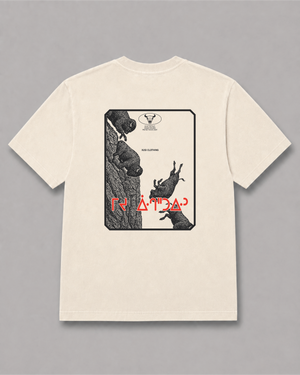
Island life happens close to the water, so layers matter. A walk along the north shore beaches suits our heavyweight cotton tee. Keep a hoodie tied at your waist. When the wind picks up off Malpeque Bay, that hoodie goes on. Crossing the Confederation Bridge in a winter wind is a job for the Revitalize Culture crewneck. For a June gathering like Mawi'omi at Scotchfort, the Golden Era ringer brings some colour. In late fall, the Black Oni long sleeve and an A-frame snapback work for errands in Charlottetown or Summerside. We also print custom team shirts in Saskatoon, handy for an island youth squad.